August 2011
August 28, 2011
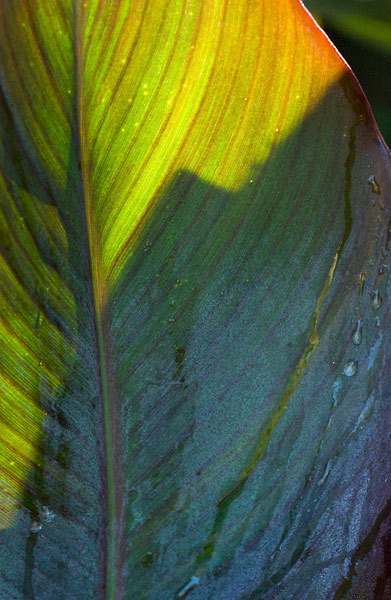
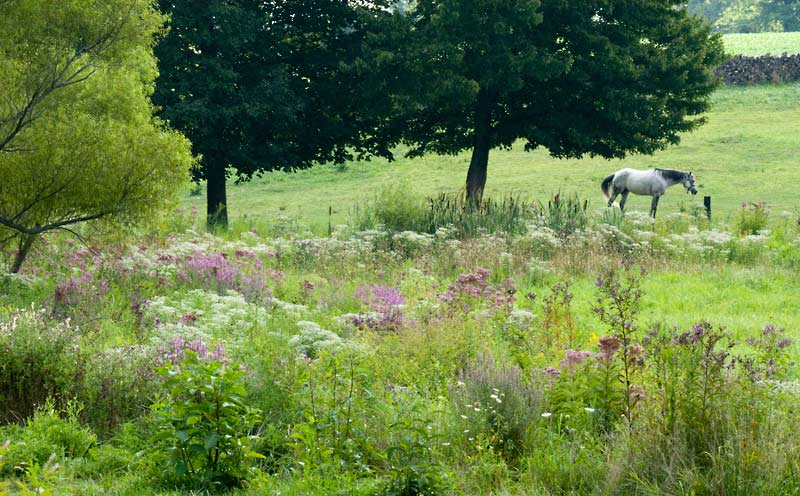
I walked down to the river yesterday for the first time in weeks. My first reward was the colorful leaves of the Wyoming Canna Lily in Schoepfle Garden proper. I shoot these plants every year, but find them just as fascinating every time. . . . Shale rocks next to or in the river are another subject that never fails to draw my attention, especially when water from rain or dew emphasizes the fractured surface. . . . Just when I had almost given up hope of seeing my favorite microbe, I came across a small patch, about four inches in diameter, of Leptothrix discophora. . . . Nearing home on the walk back, I passed our neighbor’s farm and was attracted by the three shades of pinkish wildflowers growing together in their horse pasture. The horse was a bonus. The three pinkish flowers are the invasive Purple Loosestrife (Lythrum salicaria)—that’s the brightest one—and two natives, Spotted Joe-pye Weed (Eutrochium maculatum)—the paler pink—and Tall Ironweed (Vernonia altissima)—the purplish one. I’ve wondered what or who gave Joe-pye Weed its name, and read on the web today that legend says a Colonial New England herb doctor named Joe Pye, who some say was a Native American, was skillful in treating a variety of ailments with potions he created from wild plants. He often used a group of closely related late-summer wildflowers to treat diarrhea, kidney stones, and fever, becoming famous when he stopped a typhus epidemic using his Joe-pye Weeds. . . . Googling Canna Lily, I read that this plant has been cultivated as a food crop for more than 4000 years in its native range in Central and South America. Also:
- The Canna’s pea-sized very hard seeds have been used as shotgun pellets;
- A purple dye can be extracted from the seed;
- Fibers from the stems are used to make jute and paper;
- The plants have been used to remove toxins from soils and pig waste and to remove excess fertilizer and insecticides from greenhouse runoff; and
- The Wyoming cultivar of the Canna Lily was created between 1890 and 1919 by two Americans, Antoine Wintzer and Walter Van Fleet.




These are all special in their own way….the tiny spider…:)…..the horse with those lovely wild flowers…..wow!
You have captured so much here…….so keep walking…..:)
Kay
LikeLike
August 28, 2011 at 6:27 PM
Thanks for letting your readers know which species are native and which are not.
Here in central Texas we have two species of ironweed, baldwinii and lindheimeri, but I’ve never seen the altissima.
Steve Schwartzman
http://portraitsofwildflowers.wordpress.com
LikeLike
August 29, 2011 at 7:39 AM
Hello, Steve Schwartzman:
Our Tall Ironweed may be my favorite fall flower; the purple color is so intense. You have quite a nice collection of photographs on your wildflower blog, and I like how you talk about the plants.
Linda Grashoff https://lindagrashoff.wordpress.com http://lindagrashoff.com
LikeLike
August 29, 2011 at 3:13 PM